

The Outdoor Fireplaces That Make People Never Want to Go Inside
A design-driven guide to choosing, placing, and styling an outdoor fireplace that transforms your backyard into a year-round destination.
A fireplace doesn’t just warm a space. It creates the space.
There’s a reason humans have gathered around fire for thousands of years. It’s primal, magnetic, impossible to ignore. An outdoor fireplace takes a backyard and gives it a center of gravity — a reason to stay outside when the sun drops, when the temperature dips, when the conversation gets good.
We studied the most stunning outdoor fireplace installations to decode what separates a forgettable fire feature from one that becomes the heart of a home. The difference isn’t budget — it’s design intention.


Every great outdoor fireplace falls into one of these categories
Each style isn’t just a look — it’s a complete approach to materials, placement, scale, and how the fire relates to the rest of your outdoor living space.

Coastal Warmth
Light stone, whitewashed finishes, and open sightlines that let the fire compete with the sunset.

Zen Fire
Japanese-inspired restraint — low profiles, natural stone, and the fire as a meditative focal point.

Modern Minimal
Poured concrete, clean geometry, and the flame itself as the only ornament the space needs.
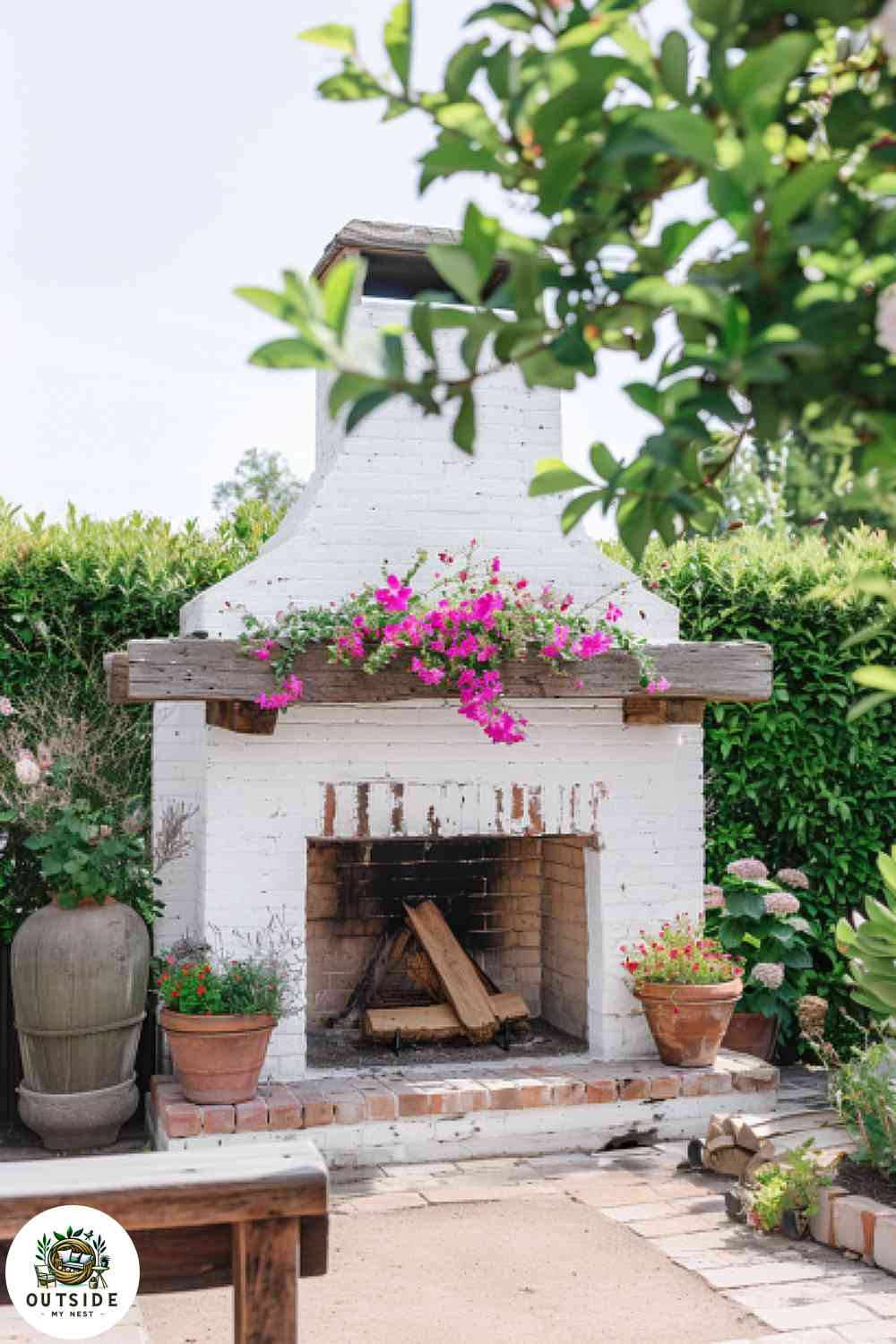
Farmhouse Hearth
Reclaimed brick, oversized mantels, and the nostalgic warmth of a hearth that feels generations old.

The Corner Statement
Tucked into an L-shaped wall, corner fireplaces turn dead space into the most magnetic spot on the patio.

Artisan Mosaic
Hand-laid tile and custom mosaic surrounds that turn the fireplace into a one-of-a-kind work of art.

The best fireplaces don’t just warm — they pull people in
Walk into any backyard with a well-placed fireplace and watch what happens. People don’t scatter across the lawn — they orbit the flame. Conversations form naturally. Chairs get dragged closer. A swinging bench or a pair of deep-set chairs positioned just right turns a fireplace into a gathering point that works for two people or twenty.
The secret is seating proximity. Too far and the fire becomes scenery. Too close and people can’t settle in. The sweet spot is four to six feet from the flame — close enough to feel the heat, far enough to see each other’s faces across it.
Arrange seating in an arc or U-shape facing the fireplace, never in a single line. The goal is conversation, not an audience — you’re designing a living room, not a theater.

Where you put the fire matters more than what you buy
A $15,000 fireplace in the wrong spot will always lose to a $3,000 fire pit in the right one. Placement is the single most impactful decision in outdoor fireplace design — and it’s the one most homeowners rush through. The fire should anchor a natural gathering zone, be visible from inside the house, and sit downwind of your primary seating.
Corner placements work brilliantly for smaller patios because they create a sense of enclosure without consuming the center of the space. The two walls become a natural backdrop, and seating wraps around the open side.

Fire below, screen above — the new living room
The outdoor entertainment fireplace has become one of the most requested designs we see. A weather-rated television mounted above a gas fireplace creates a focal wall that functions exactly like an indoor living room — except the ceiling is the sky. Game days, movie nights, or just the evening news with a glass of wine become completely different experiences when there’s an open flame beneath the screen.
The key to making this combination work is proportion. The fireplace opening should be at least as wide as the screen above it, and the mantel or stone surround should frame both elements as a single composition rather than two separate features stacked on top of each other.
Use a linear gas fireplace (wide and low) beneath the screen rather than a traditional arched opening. The horizontal lines echo the TV’s shape and create a unified wall that reads as one design statement.

When the fireplace and the kitchen become one wall
The most ambitious outdoor fireplace projects we’ve seen integrate the fireplace directly into an outdoor kitchen run. The fireplace anchors one end, the grill stations occupy the middle, and storage and prep surfaces complete the other end. It’s a single, cohesive structure that eliminates the scattered feel of separate features dotted around the patio.
The practical advantage is enormous: one gas line, one stone or brick finish, one roofline if covered. The visual advantage is even bigger — it reads as architecture, not furniture, and gives even a modest backyard the presence of a resort.

Elevation changes turn a fireplace into theater
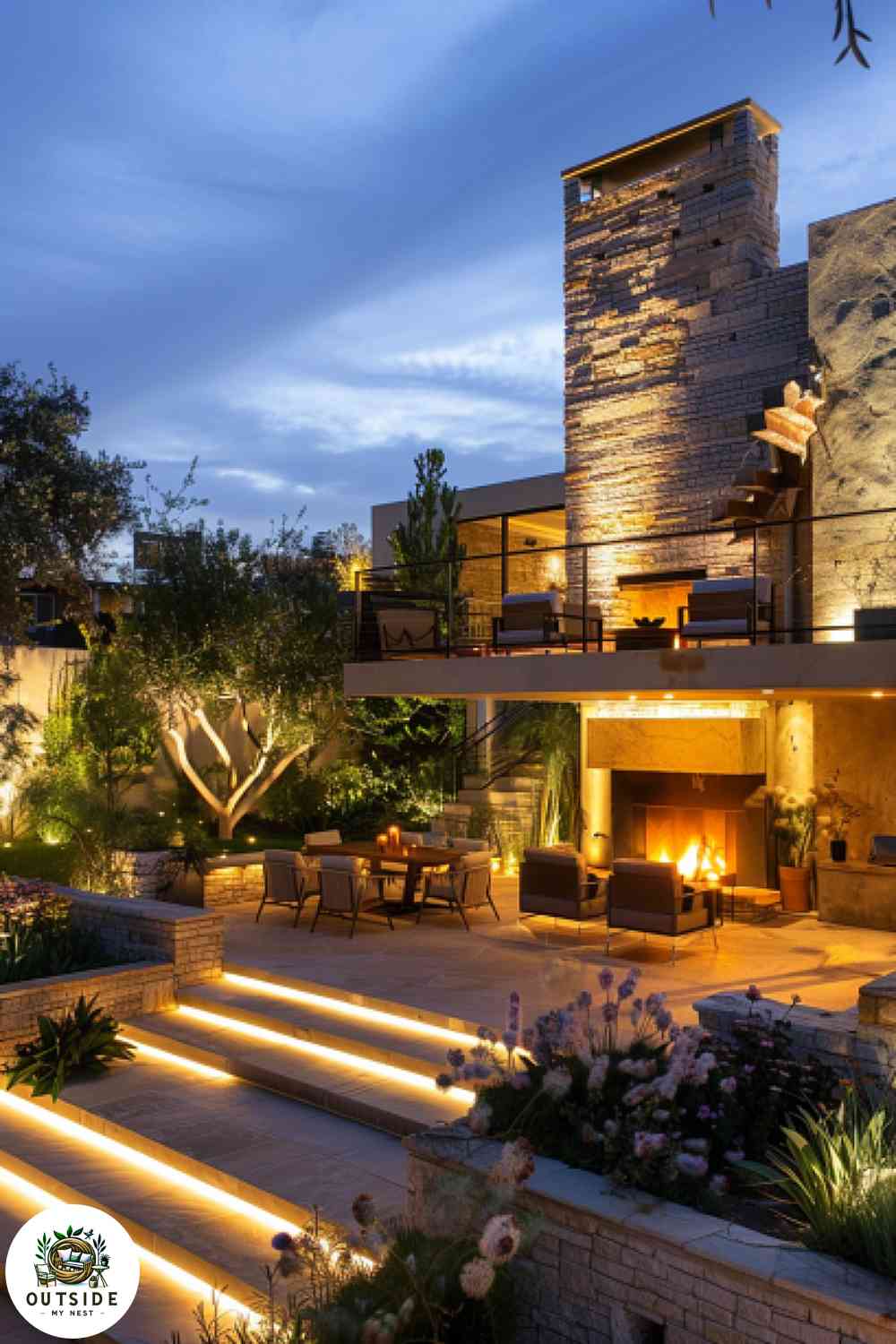
When the fireplace sits at the intersection of two patio levels — a raised dining area stepping down to a sunken lounge, for example — something remarkable happens. The fire becomes visible from every vantage point in the yard. People on the upper level look down at the flames. People on the lower level look across at them. The fireplace becomes a shared centerpiece that connects distinct zones without walls.
Multi-level designs also solve a common problem: how to make a large patio feel intimate rather than like an empty parking lot. The level changes create natural room divisions, and the fireplace is the element that ties them all together.
Position the fireplace at the transition between levels so it’s visible from both. Built-in seating walls at the step-down double as extra seating and make the fire the undeniable heart of the space.
Every flame tells a different story
From coastal retreats to rustic farmhouses, sleek contemporary builds to mosaic-wrapped hearths — the range of what’s possible when fire meets design intention.
Four principles that make any outdoor fireplace work
Regardless of style, budget, or backyard size — the fireplaces that feel “right” all follow these same structural ideas.
Scale to the Space
A fireplace should feel proportional to its surroundings. Too small and it disappears. Too large and it overwhelms. The opening width should be roughly one-third the width of the wall or seating area it anchors.
One Material Story
The best fireplaces commit to one or two materials — stacked stone, poured concrete, painted brick — and let the fire be the contrast. Mixing too many finishes makes the hearth feel like an afterthought.
Light in Layers
Firelight alone isn’t enough. Add low-voltage downlights on the mantel, step lights at the base, and ambient string lights overhead. The fire provides the mood — the supporting lights provide usability.
Sight Lines First
Before choosing a style, stand in every spot people will use — the kitchen, the dining table, the back door — and make sure the fire is visible from each one. A fireplace nobody can see is a fireplace nobody uses.
Ready to design a fireplace that anchors your backyard?
Get a personalized consultation with our outdoor fireplace design team — we’ll help you choose the right style, placement, and materials for your space.